
Every Fourth of July, Americans gather with family and friends to celebrate the birth of our nation. We fire up the grill, watch fireworks light up the night sky, and perhaps raise a glass in honor of the freedoms won nearly 250 years ago.
If that glass contains bourbon or American whiskey, you’re participating in a tradition that reaches much deeper into our nation’s history than most people realize. Whiskey and independence are connected in many ways.
Whiskey didn’t simply become America’s native spirit by accident. It helped build the country long before bourbon earned its place as a uniquely American whiskey. The story begins with the Revolutionary generation itself.
George Washington
One of the greatest surprises in American whiskey history is that George Washington was not only the Father of Our Country but also one of the nation’s most successful distillers. After leaving the presidency, Washington established a commercial distillery at Mount Vernon. By 1799, it produced nearly 11,000 gallons of rye whiskey annually, making it one of the largest distilleries in the young United States. While many remember Washington for leading armies and presiding over the Constitutional Convention, few realize he also understood the value of turning grain into whiskey.
His success reflected something much larger happening across early America.
The Beginning of the Soldier Distiller
During the Revolutionary War, whiskey served practical purposes far beyond celebration. Soldiers often received spirits as part of their rations because clean drinking water wasn’t always available, and distilled spirits traveled better than beer. Whiskey also boosted morale during long campaigns and, in some cases, became a form of payment when hard currency was scarce.
When the war ended, thousands of veterans headed west in search of opportunity. Many settled in Kentucky after receiving land grants or purchasing inexpensive frontier land. They brought with them generations of distilling knowledge learned from families of Scottish, Irish, and German descent. Kentucky offered fertile soil, abundant corn, limestone-filtered water, and forests filled with oak. Those ingredients created the perfect environment for what would eventually become bourbon.
Whiskey Currency
In many frontier communities, whiskey was more valuable than cash.
A farmer might struggle to transport hundreds of pounds of corn over rough mountain roads, but by distilling that grain into whiskey, he could carry far more value in a few barrels. Whiskey became a practical currency that could pay wages, purchase livestock, settle debts, or be traded for supplies. On the American frontier, a barrel of whiskey often represented both hard work and financial security.
The First Whiskey Tax in America
That dependence on whiskey led to one of the earliest constitutional tests facing the new republic.
In 1791, the federal government imposed an excise tax on whiskey to help pay off debts from the Revolutionary War. Farmers in western Pennsylvania believed the tax unfairly targeted small distillers who relied on whiskey to survive. Their resistance eventually erupted into what became known as the Whiskey Rebellion.
The irony is impossible to ignore. American soldiers had just fought for independence from Britain, only to find themselves protesting taxes imposed by their own government.
President George Washington responded by personally leading nearly 13,000 militia troops to enforce federal law. The rebellion ended with relatively little bloodshed, but it demonstrated that the Constitution gave the new government the authority to maintain order. It remains one of the defining moments in early American history, and whiskey sat squarely at the center of it.
Celebrating the Fourth
The Fourth of July celebrations of the late eighteenth and early nineteenth centuries looked remarkably familiar in some ways. Communities gathered for parades, militia demonstrations, public dinners, patriotic speeches, music, and fireworks. A popular custom involved offering a series of patriotic toasts honoring the nation, the Constitution, military heroes, and the principles of liberty. Those toasts often featured whiskey alongside rum, cider, and beer, depending on what was available locally.
While bourbon had not yet emerged as the dominant American whiskey, the culture surrounding whiskey was already woven into the fabric of Independence Day celebrations.
That is one reason I enjoy pouring a glass of American whiskey every Fourth of July. It isn’t simply about tradition or enjoying a good bourbon on a summer evening. It’s a reminder that whiskey has been part of America’s story from the beginning. It traveled with settlers into Kentucky, helped establish frontier communities, supported farmers, tested the authority of a new government, and even became the business of our first president.
Appreciate the History
As bourbon enthusiasts, we often celebrate master distillers, limited releases, and historic brands. Those stories deserve to be told. But every Independence Day offers an opportunity to remember the people who laid the foundation for the whiskey industry we enjoy today. Revolutionary soldiers, frontier farmers, and veteran settlers were all early distillers who helped create what would eventually become America’s native spirit. Green River Distillery issued a special bottle honoring the 250 years of the U.S. Army. It is just one of many patriotic bottles issued this year.
So this Fourth of July, when you raise a glass of bourbon or rye, take a moment to appreciate that you’re not just enjoying a fine whiskey. You’re participating in a tradition that stretches back to the earliest days of the American experiment.
In many ways, the story of American whiskey is the story of America itself. Both were forged through perseverance, shaped by adversity, and strengthened by generations willing to build something that would last.
Happy Independence Day, and cheers to the enduring spirit of America.Thank you for reading a little story about Whiskey and Independence.
Great read once again Don!
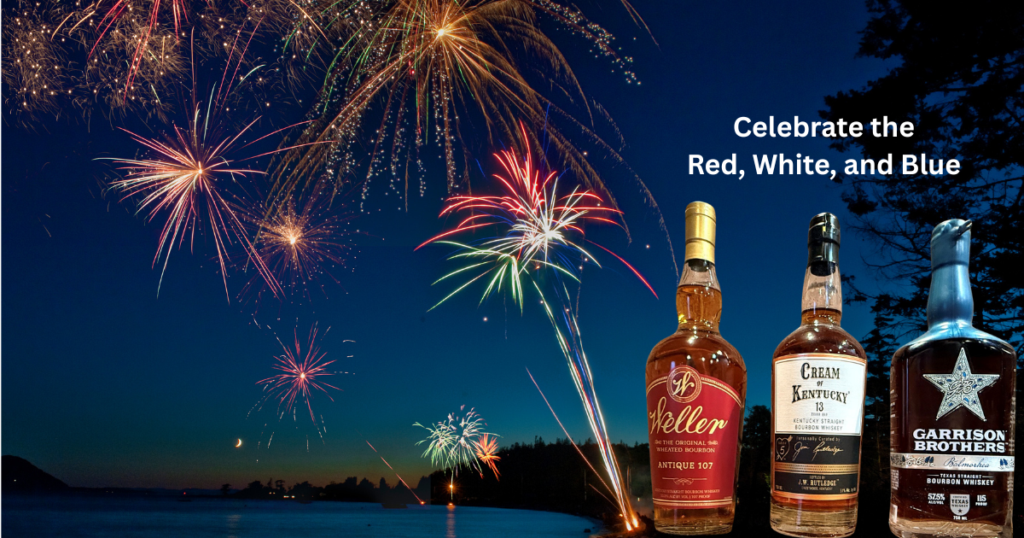
Live the Red, White, and Blue bourbon tribute too!
Chris,
Thank you. I truly appreciate your comments. You are one of the few that noticed the red, white and blue bottles.