
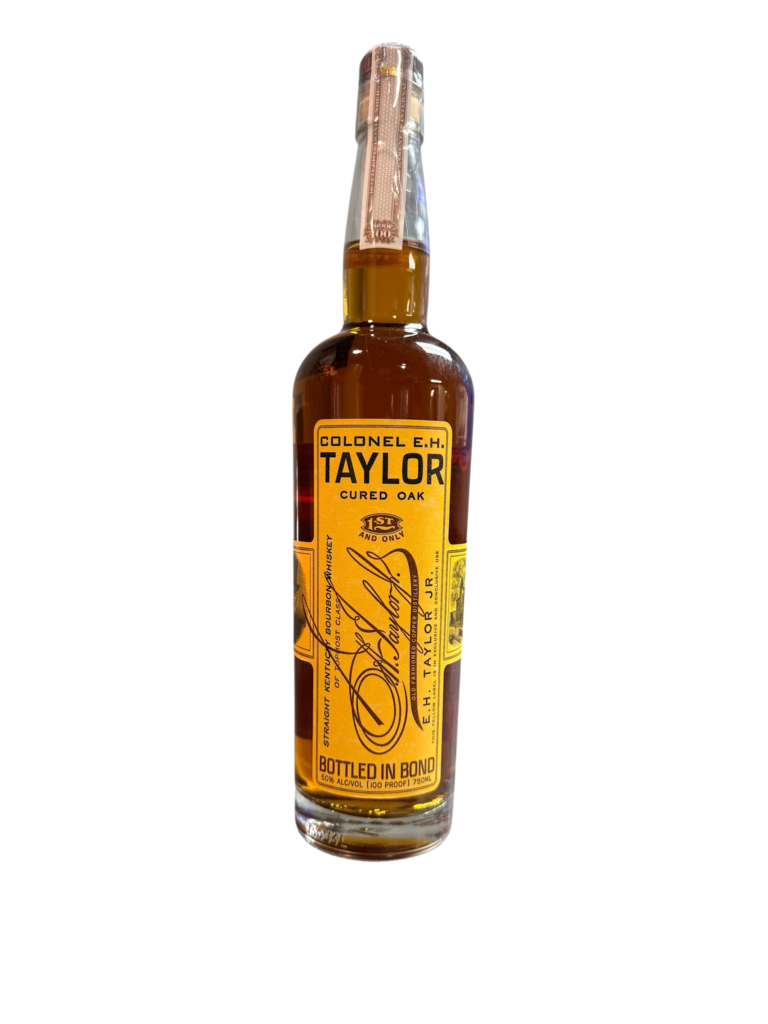
When I reviewed E. H. Taylor Cured Oak Bourbon recently, I expected the conversation to focus on the whiskey itself. Instead, nearly every follow-up discussion drifted toward one number. Eleven hundred dollars.
The suggested retail price is around $80, yet bottles began appearing almost immediately on the secondary market for nearly fourteen times that amount. That raises a question worth asking, not just about this release, but about bourbon collecting as a whole. Is any bottle of whiskey really worth paying more than ten times its original price? Here is our newly released video reviewing E. H. Taylor Cured Oak.
Buying Exclusivity
I have sampled hundreds of bourbons over the years. Some have been exceptional. Some have been disappointments. Most fall somewhere in between. One thing I’ve learned is that price and enjoyment rarely move together in a straight line. In fact, once you move beyond a certain point, every additional dollar tends to buy exclusivity rather than a dramatically better drinking experience.
That doesn’t mean E. H. Taylor Cured Oak isn’t special. It is an innovative release from the Buffalo Trace Distillery. Instead of relying solely on traditional seasoning methods, the oak used for these barrels underwent a longer curing process that changes how the wood interacts with the whiskey. It is exactly the kind of experiment many whiskey enthusiasts hope to see from one of America’s most respected distilleries. But is that innovation worth $1,100?
For me, the answer is no.
When Bourbon Became a Commodity
It wasn’t always this way.
Twenty years ago, finding great bourbon often meant walking into a local liquor store and choosing between bottles sitting quietly on the shelf. Van Winkle, Blanton’s, Weller, and other bourbons weren’t mythical creatures. They were simply excellent bourbons.
The explosion began during the early 2010s.
American whiskey experienced an unprecedented surge in popularity. Social media introduced collectors to bottles they had never seen. Facebook groups dedicated to bourbon trading multiplied. YouTube reviewers showcased rare finds. Instagram was filled with carefully arranged bottle lineups, and suddenly owning hard-to-find bourbon became almost as important as drinking it. Scarcity created excitement. Excitement created demand. Demand created flipping.
Before long, people who had little interest in bourbon itself realized they could buy an allocated bottle at retail and immediately sell it for several times its original price. Collecting gradually gave way to investing, and investing often became speculation.
The secondary market exploded. Unfortunately, so did hoarding.
Instead of buying one bottle to enjoy, many buyers began purchasing every bottle they could find. Some hoped to flip them for profit. Others feared they would never see the bottle again. That fear only made the problem worse.
Economists have a name for this behavior. Consumers respond to perceived scarcity by purchasing more than they normally would, creating an even greater shortage than actually exists.
The bourbon world has lived through that cycle for more than a decade.
The Real Cost of Chasing Unicorns
There is another cost that rarely gets discussed. Suppose someone spends $1,100 on a bottle with an $80 MSRP. That same money could purchase a worthwhile whiskey collection instead. A collection that would allow you to compare mash bills, distilleries, and age statements. A collection that would help you better understand your whiskey palate.
Imagine walking away with several excellent bottles such as Russell’s Reserve Single Barrel, Knob Creek 12 Year, Wild Turkey Rare Breed, Jack Daniel’s Single Barrel Barrel Proof, Maker’s Mark Cellar Aged if you can find it near retail, and several outstanding craft distillery releases. You would have enough whiskey to explore different mash bills, proofs, finishes, and distilling styles for months. Instead, you have one bottle. One extraordinary bottle, perhaps, but still just one bottle.
That doesn’t seem like a winning trade to me.
The Psychological Trap
The hardest part about allocated bourbon isn’t finding it.
It’s convincing ourselves that we need it.
We’ve all experienced it. A new limited release appears online. Influencers rave about it. Stores announce lotteries. Secondary prices climb by the hour. Suddenly, the bottle seems more desirable simply because everyone else wants it.
Psychologists call this the scarcity effect. We naturally assign greater value to things that appear difficult to obtain. The whiskey hasn’t changed. Only our perception has.
My Bourbon Philosophy
I’ve reached a point where I refuse to participate in artificially inflated pricing.
If I find an allocated bottle at or near retail, fantastic. I’ll happily buy it, open it, and enjoy it with friends. If I don’t find one, life goes on. There are simply too many outstanding bourbons sitting on shelves today to lose sleep over missing one release.
Ironically, the bourbon market itself seems to be correcting. Over the past year, I’ve noticed bottles returning to shelves that disappeared during the height of the bourbon boom. Distilleries have expanded production, demand has cooled, and many excellent whiskies are once again available without camping outside liquor stores or paying outrageous premiums.
That’s good news for everyone who enjoys drinking bourbon.
So, Is Any Bottle Worth Ten Times MSRP?
Could there be someone for whom the answer is yes? Absolutely.
If you’re a serious collector with significant disposable income, or you’re searching for the final bottle to complete a once-in-a-lifetime collection, the value equation becomes personal rather than practical. But for most bourbon drinkers, paying ten or fourteen times retail isn’t really about the whiskey. It’s about owning something other people can’t.
There’s nothing wrong with collecting rare bottles. Collections preserve history, celebrate craftsmanship, and bring enthusiasts together. The problem begins when scarcity becomes more important than the spirit inside the bottle.
For me, bourbon has always been about sharing stories, discovering new distilleries, and enjoying great whiskey with good friends. No bottle can improve on that simply because someone attached an $1,100 price tag to it. Many of you know that I have recently experienced a loss so devastating that the pain never stops. What alleviates that pain, even for a short time, is a friend who calls and offers to have a drink with me, or just inquires how I am doing. It is not chasing down an overpriced bottle. It is about a connection with friends, not a contest to see what I can buy. It is about sharing memories, stories, and experiences. It is the quality of the moment vs. finding the unicorn bottle.
So if I happen to find E. H. Taylor Cured Oak sitting on a shelf for around MSRP, I’ll gladly bring it home. In fact, I would pay two or three times MSRP. If the only option is paying over a thousand dollars? I’ll leave it there, buy several outstanding bottles instead, and never feel like I missed out.
Sometimes the smartest purchase in bourbon is the one you decide not to make.
Don, I agree with you 100% on this post. Paying over-inflated prices just for the exclusivity when there are so many other fine bourbons available just isn’t my thing. But one great alternative to paying for the exclusivity rather than the quality of the product is when you can purchase an ounce or two from your favorite local restaurant or bar (in my case Charlie’s Still on Main). Some may still consider it over priced even at that level, but I enjoy tasting the bourbon rather than hunting exclusivity.
Rob,
I truly appreciate your input. Thanks for commenting. Your approach makes perfect sense.