
A longtime supporter of Bourbonfool.com recently reached out with a deceptively simple question:
Is the drinking straw connected in any way to bourbon whiskey?
It’s the kind of question that sounds like bar trivia until you really think about it. Mint juleps. Silver cups. Derby Day. Straws feel so baked into bourbon culture that it almost seems obvious they must share an origin story.
As it turns out, the truth is a little more interesting than the myth.
Bourbon Didn’t Invent the Straw—but It Helped Make It Necessary
Let’s get the straight answer out of the way first. Bourbon did not directly lead to the invention of the drinking straw. No distiller, bartender, or Kentucky farmer filed a patent that changed sipping forever.
That credit goes to Marvin C. Stone, who patented a paper drinking straw in the late 19th century. His invention wasn’t about bourbon specifically—it was about control, consistency, and taste. Natural straws made from plant stems were common at the time, but they often collapsed, got soggy, or, worse, added their own grassy flavor to the drink.
Stone wanted something neutral. Something reliable. Something that didn’t interfere with what was in the glass.
And while bourbon wasn’t named in the patent, it fits perfectly into the problem he was trying to solve.
The Mint Julep Changes Everything
This is where bourbon steps onto the stage.
The mint julep predates Stone’s patent by decades. It was already well established as a Southern drink long before paper straws existed. Crushed ice. Fresh mint. Sugar. Bourbon. Served cold enough to frost the outside of the cup.
Anyone who has made a proper julep knows the issue immediately: without a straw, you’re fighting mint leaves and ice just to reach the bourbon underneath. The straw wasn’t a garnish—it was a practical solution.
Early julep drinkers used whatever they had. Hollow reeds. Grass stems. Reusable metal tubes. The goal wasn’t convenience; it was access. The straw allowed the drinker to sip the cold, diluted bourbon below the surface without chewing the garnish.
In that sense, bourbon did not invent the drinking straw, but it gave the straw a job. Bourbon and the drinking straw became connected for one of the great drinking rituals at the annual Kentucky Derby.
Derby Day and the Power of Ritual
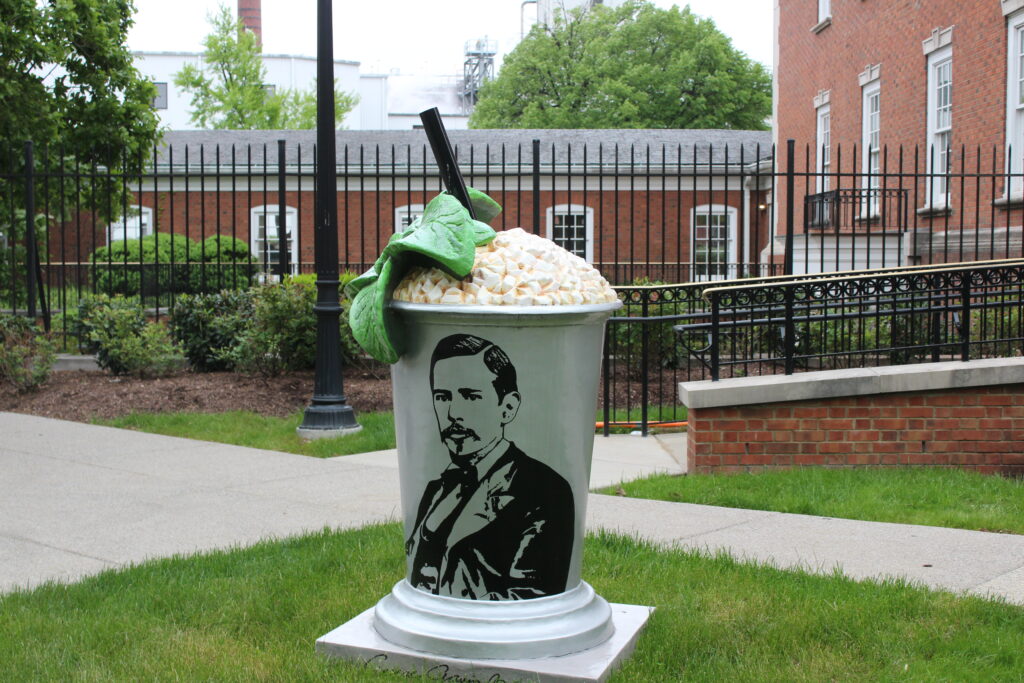
When the Kentucky Derby turned the mint julep into a national symbol, the presentation became just as important as the drink itself. The silver cup. The crushed ice. The mint bouquet. The straw.
Together, they created an image that stuck.
Once a ritual becomes tradition, it spreads. The straw became associated not just with a cocktail, but with refinement, leisure, and a specific way of drinking. That cultural weight matters. Tools survive when people keep using them, and bourbon drinkers had plenty of reasons to keep reaching for a straw.
Straws Are Far Older Than Bourbon
Forgive me, but when I zoom out far enough, the story of the straw gets much older—older than bourbon, whiskey, or even distillation itself.
Long before glassware and cocktails, people were fermenting grains and drinking from communal vessels. Those early drinks weren’t filtered. Sediment was a problem. Floating solids were unavoidable.
The solution was simple: drink from the bottom.
Archaeological evidence shows that ancient civilizations used long tubes—primitive straws—to sip fermented beverages while avoiding debris. These weren’t novelty items. They were practical tools designed to enable communal drinking.
In other words, humans have been using straws for thousands of years, not for comfort, but for survival and sanitation.
Another Living Example: Filtered Straws
There’s also a reminder that straw culture didn’t stop in the ancient world.
In South America, yerba mate has long been consumed using a metal straw with a built-in filter. The purpose is the same as that of those early beer straws: separate liquid from solid. Sip without swallowing leaves. Control the experience.
Different drink. Different culture. Same idea.
It’s proof that when a beverage demands a specific way of drinking, people design tools to match. There are modern “drinking straws” that are part of a water purification system for hikers and outdoor enthusiasts.
Bourbon did not invent the drinking straw.
But bourbon—especially through the mint julep—played a meaningful role in making the straw familiar, accepted, and even expected in American drinking culture.
Bourbon didn’t create the tool. Bourbon helped define the ritual.
And that’s often how bourbon history works. It doesn’t always originate the idea—but it refines it, repeats it, and embeds it so deeply that it feels inevitable.
Sometimes the smallest details—the straw in the glass—tell the biggest stories about how we drink.
Thanks for the clarification, loved the article!