
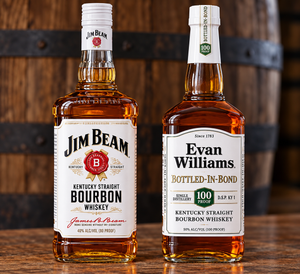
Today, I am going to step away from the trend of chasing expensive bottles and instead, talk about two bottles that have been important in bourbon history. I often compare different bottles for the best value and flavor. The Jim Beam White Label and Evan Williams White Label (Bottled-in-Bond) are two widely available and affordable options in the bourbon world. While both hail from Kentucky and have storied histories, they bring distinct characteristics. This blog post will explore the differences in history, production, flavor, and overall value between these two well-known bourbons.
Historical Background
Jim Beam White Label
One of the most iconic names in bourbon, Jim Beam, traces its history back to 1795, when Jacob Beam sold his first batch of whiskey. However, the modern Jim Beam White Label was officially introduced to the market in 1933, following the repeal of Prohibition. This standard-bearing bourbon has since become one of the best-selling whiskeys in the world. You may remember that this is one of the first bourbons I ever drank on a regular basis. You can watch that video HERE.
Evan Williams White Label (Bottled-in-Bond)
Evan Williams, named after one of Kentucky’s earliest distillers, was established in 1783. The Evan Williams White Label Bottled-in-Bond Bourbon was introduced much later, gaining popularity due to its adherence to the Bottled-in-Bond Act 1897. This label guarantees that the bourbon is aged for at least four years, comes from a single distillery, and is bottled at 100 proof. This is just one of many bourbon labels produced by the Heaven Hill Distillery in Bardstown, Kentucky.
Mash Bill & Production
Both bourbons share similar Kentucky roots and traditional distillation methods, but their mash bills and proof levels set them apart.
- Jim Beam White Label: 75% corn, 13% rye, and 12% malted barley. It is bottled at 80 proof (40% ABV) and aged for around four years.
- Evan Williams White Label: 78% corn, 10% rye, and 12% malted barley. As a Bottled-in-Bond bourbon, it is always bottled at 100 proof (50% ABV) and aged for at least four years.
Evan Williams White Label’s higher proof gives it a more robust presence, while Jim Beam White Label is known for its lighter and more approachable character.
Tasting Notes
Jim Beam White Label
- Nose: Vanilla, caramel, and light oak with a touch of corn sweetness.
- Palate: Soft and sweet, featuring vanilla, toasted oak, and a hint of spice.
- Finish: Short to medium with lingering caramel and mild spice.
Evan Williams White Label
- Nose: Rich caramel, oak, and a noticeable ethanol presence due to its higher proof.
- Palate: Fuller-bodied with deep caramel, toasted nuts, vanilla, and a peppery spice.
- Finish: Long and warming with pronounced spice and oak.
Price & Availability
Both bourbons are widely available across the U.S. and internationally.
- Jim Beam White Label: Typically priced around $20-$25 for a 750ml bottle, making it one of the most affordable and recognizable bourbons.
- Evan Williams White Label: Slightly higher at $22-$27 due to its Bottled-in-Bond designation and higher proof.
However, both of these can typically be found on sale throughout the year.
Which One Should You Choose?
Jim Beam White Label is an excellent option if you prefer a lighter, more approachable bourbon that’s easy to sip neat or mix into cocktails. It’s smooth and sweet and has an iconic presence in the whiskey world.
On the other hand, if you enjoy a more full-bodied, flavorful bourbon with a bit more kick, Evan Williams White Label is the clear winner. Its higher proof and richer profile make it excellent for sipping or standing out in cocktails.
Final Verdict
Jim Beam White Label and Evan Williams White Label are excellent budget-friendly bourbons. If you’re new to bourbon, Jim Beam White Label provides an easy introduction. However, for those seeking a more substantial, more complex experience at a similar price point, Evan Williams White Label offers tremendous value and depth of flavor.
At the end of the day, personal preference will be the deciding factor. I know many bourbon enthusiasts that will turn up their nose at either of these bottles. However, they deserve mention, and should not be overlooked by a bourbon newcomer on a limited budget. Whether you choose the smooth, easy-drinking Jim Beam or the bolder, more complex Evan Williams, both bourbons proudly uphold Kentucky’s whiskey-making tradition. Cheers!
Don, Thanks for talking about affordable bourbons. I enjoy Evan Williams Black which I think more comparable to Jim Beam White. Bottled in Bond bourbons seems more “special” to me.
Your review makes me want to try Jim Beam. I know I’ve had it but don’t remember it.
Greg