
American whiskey can generally be divided into two major categories: straight whiskey and blended whiskey. While both legally qualify as American whiskey, they differ dramatically in production methods, flavor, quality, and price.
American Straight Whiskey
American straight whiskey is one of the two primary types of American whiskey. Distillers must produce straight whiskey at less than 160 proof, although most distilleries run their stills well below that legal maximum. In reality, many straight whiskeys come off the still closer to 140 proof to preserve more flavor and character.
After distillation, the spirit ages in a new charred oak container, typically a barrel. If the whiskey meets all other legal requirements, producers can label it “straight whiskey” after a minimum of two years of maturation.
Prominent Styles of Straight Whiskey
Most straight whiskey produced in the United States falls into the straight bourbon category, but Tennessee whiskey also holds a major place in the market. The primary difference between bourbon and Tennessee whiskey is the charcoal filtering process commonly known as the Lincoln County Process.
Historically, Tennessee distillers passed this filtering method down through generations as a matter of tradition. In 2013, Tennessee officially codified the practice into state law, requiring Tennessee whiskey producers to charcoal filter their whiskey before barreling.
Wheat, Rye, and Corn Straight Whiskeys
After bourbon and Tennessee whiskey, straight rye whiskey remains the next most popular category, followed by straight wheat whiskey and straight corn whiskey.
The dominant grain in the mash bill determines the whiskey type. A mash bill containing at least 51% corn typically qualifies as bourbon. A whiskey with 51% or more rye qualifies as rye whiskey, and the same principle applies to wheat whiskey and other grain-forward styles.
Straight Corn Whiskey vs. Bourbon
If both bourbon and corn whiskey contain a majority percentage of corn in the mash bill, what separates them?
Straight corn whiskey must contain between 80% and 100% corn in the mash bill. Unlike bourbon, however, corn whiskey never ages in a new charred oak barrel. In fact, corn whiskey does not require aging at all. If producers age it, they must use either used barrels or uncharred new oak containers.
That distinction dramatically changes the flavor profile and overall character of the whiskey.
American Blended Whiskey
Blended whiskey represents the second major type of American whiskey.
During the early 20th century, whiskey regulators wanted to classify blended whiskey as “imitation whiskey.” Producers strongly opposed the term because they believed it cheapened their product. In 1909, President William Howard Taft settled the debate by ruling that American whiskey would officially fall into two categories: straight whiskey and blended whiskey.
Today, whiskey historians refer to that ruling as the Taft Decision.
The Definition of American Blended Whiskey
American blended whiskey combines two or more different types of whiskey. Most blends combine straight whiskey with neutral grain spirits.
By law, the whiskey portion must account for at least 20% of the blend per proof gallon. In practical terms, many American blended whiskeys contain only 20% to 25% straight whiskey, while the remaining 75% to 80% consists of neutral grain spirits similar to vodka.
These blends may also contain artificial coloring and flavoring, and many producers historically sold them in dark bottles.
American Blended Whiskey Brands
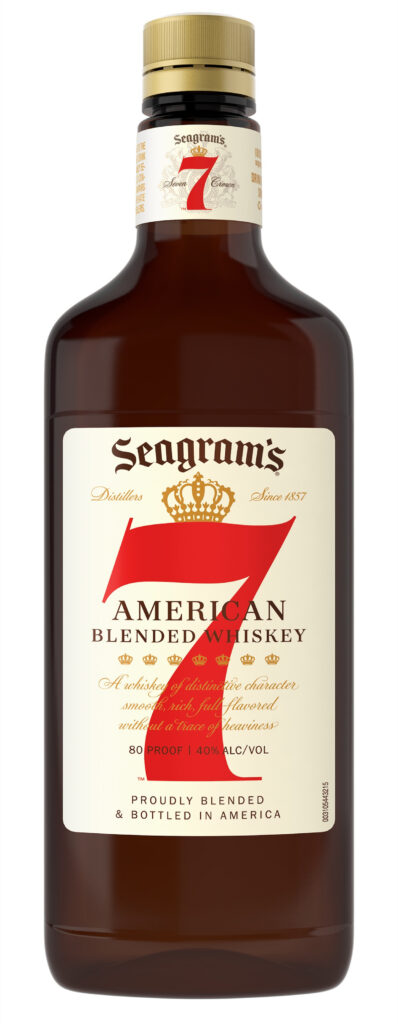
Several recognizable brands fall into the blended whiskey category, including Calvert, Imperial, Kessler, and the best-selling American blended whiskey, Seagram’s 7 Crown.
Blended whiskeys cost less to produce and generally are not designed for sipping neat. The whiskey character still comes through, but much more lightly than in a straight whiskey. Because of that lighter profile, blended whiskey often works best in mixed drinks.
The classic Seven and Seven remains one of the best-known examples.
A Blended Whiskey Exception
Not every whiskey blend qualifies as blended whiskey under the traditional definition.
If producers combine two or more straight whiskeys of the same type, the finished product may still qualify as straight whiskey. For example, blending multiple straight bourbons together still produces straight bourbon whiskey.
However, when producers blend different straight whiskey types together — such as straight bourbon and straight rye whiskey — the label must reference the blend. One well-known example is High West Bourye.
Conclusion
Blended whiskey costs significantly less to manufacture than straight whiskey. Straight bourbon often spends years aging in barrels, sometimes for 2, 4, 8, or even 12 years or longer. That aging process requires warehouse space, barrel investment, evaporation loss, and time, all of which increase the final bottle price.
Blended whiskey offers a faster and less expensive production path by combining neutral grain spirits with a smaller percentage of straight whiskey.
I actually have a fun experiment involving blended whiskey and straight whiskey that surprises almost everyone who tries it. Hit me up in the comments, and I’ll share it with you.
Cheers
Okay, I’m curious. What’s the experiment?
Okay everyone. Take a bottle of bourbon you enjoy. Do not use anything expensive for obvious reasons. Pour 1 part of that bourbon into a container and add 3 parts neutral grain spirits (vodka). Mix them well, and you have created your own American blended whiskey. This will give you a visual example of what is normally done when blends are created. Taste it, use it in a cocktail, and see why it is profitable for distillers to produce blended whiskey.
I’d like to play a game with the summit brothers and mess with their heads. What the “experiment”?
Okay everyone. Take a bottle of bourbon you enjoy. Do not use anything expensive for obvious reasons. Pour 1 part of that bourbon into a container and add 3 parts neutral grain spirits (vodka). Mix them well, and you have created your own American blended whiskey. This will give you a visual example of what is normally done when blends are created. Taste it, use it in a cocktail, and see why it is profitable for distillers to produce blended whiskey.