
Origin, First Use, and What It Really Means
Walk into any well-stocked whiskey shop today, and you’re likely to see it on a label: Cigar Blend or Cigar Batch. It sounds specific, intentional, and it sounds like it should mean something concrete. This article will help you understand cigar blend bourbon.
But here’s the reality most people don’t realize right away—“cigar blend” is not an official category of whiskey. It’s not regulated, not defined by law, and not consistent from one distillery to the next. I have personally sampled multiple “cigar batch” whiskeys, and I have enjoyed them all. However, some are better than others.
So what does it actually mean? Where did the term come from? And which brand used it first?
Let’s break it down.
The Origin of “Cigar Blend” Whiskey
The idea behind cigar blend whiskey is rooted in one simple concept: pairing.
Long before American distillers began using the term, Scotch producers were already experimenting with “cigar malts.” These were whiskies designed to stand up to the intensity of cigar smoke—richer, heavier, and more robust than your typical dram.
American whiskey picked up this idea during the craft boom of the 2010s. As distillers and blenders gained access to a wider range of finishing barrels and older sourced stocks, the opportunity emerged to create something more layered and expressive—something that could hold its own alongside a cigar.
The term “cigar blend” began to appear as a way to describe that intention.
The First Bourbon to Use “Cigar Blend”
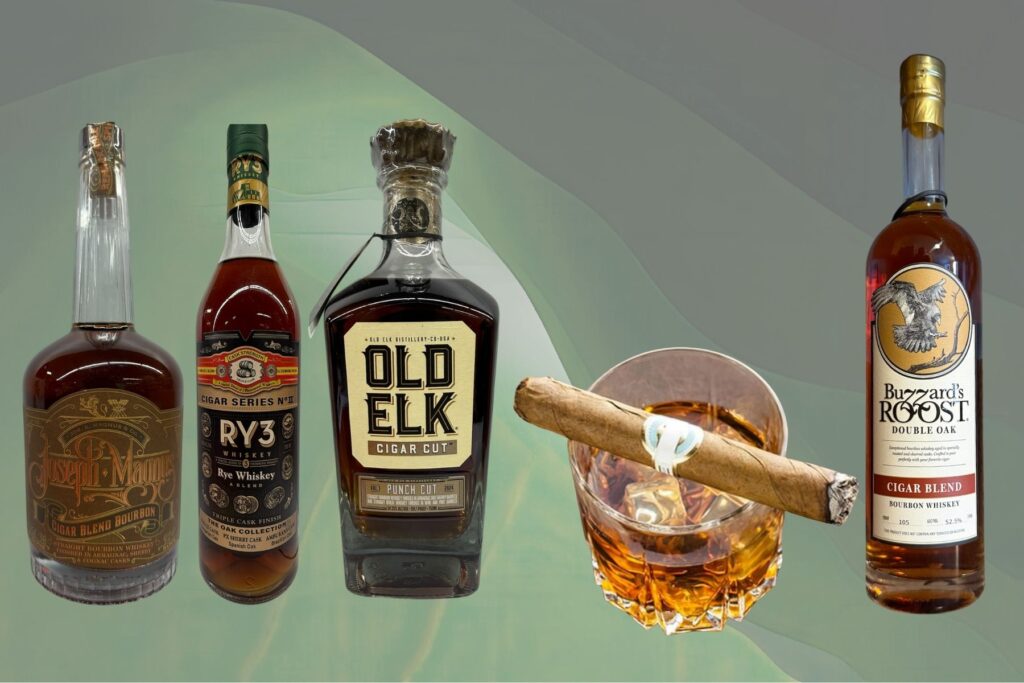
The first widely recognized bourbon to formally use the term was Joseph Magnus Cigar Blend Bourbon, released in 2016 by Jos. A. Magnus & Co. I remember visiting the Coppercraft distillery in Holland, Michigan, and being poured a sample of this whiskey before it was widely available. It was then quite amazing. My only regret was the fact that I did not have a cigar to pair it with.
Developed by blender Nancy Fraley, this release set the tone for what cigar blend bourbon could be. It combined older sourced bourbons and finished them in a combination of Armagnac, Cognac, and Sherry casks. The goal was not subtlety. It was structure, richness, and depth—flavors that could complement, rather than disappear behind, a cigar.
That release didn’t just introduce a product. It effectively created a new category, even if unofficial.
What Does “Cigar Blend” Actually Mean?
At its core, cigar blend whiskey is about building a profile that can stand up to cigar smoke. That usually means a whiskey with more intensity, more body, and more layered flavor than a standard release.
Beyond that, the definition becomes far less precise.
There is no governing body that determines what qualifies as a cigar blend. Instead, distillers rely on a loose set of shared ideas and techniques. One of my favorite cigar blend pours is Buzzard’s Roost Double Oak Cigar blend. For reference, the bottle is pictured below, and there is a link to a video review at the end of this paragraph. When I spoke with the great people at Buzzard’s Roost, they mentioned that their cooperage creates specially crafted barrels with a specific toast profile. This adds to their specific “cigar” notes that can be tasted and nosed. Be sure to include this bottle when you are looking for a “cigar” style pour. To see a video review of this bottle, follow this LINK.
How Distillers Create a “Cigar Blend”
While there is no single formula, several common approaches show up again and again across cigar blends and cigar batch releases.
Multi-Cask Finishing
One of the most common techniques is secondary maturation in bold, expressive casks. These can include Armagnac, Cognac, Sherry, Port, or Rum barrels, and more recently, even exotic woods like Amburana.
These finishes add layers of dark fruit, spice, sweetness, and tannin. The goal is to create a whiskey that doesn’t get washed out when paired with a cigar.
Blending Multiple Components
Many cigar blends are not single-barrel expressions. Instead, they are carefully constructed blends of different mash bills, ages, and barrel types.
This approach mirrors the way cigars themselves are made, where multiple tobaccos are blended to create balance and complexity.
Higher Proof and Heavier Mouthfeel
Cigar blend releases often lean toward higher proof, though it is not a requirement. More importantly, they tend to emphasize a richer, fuller texture on the palate.
That weight matters. A thin whiskey simply won’t hold up when paired with a full-bodied cigar.
Flavor Profile as the True Metric
If there is any real “standard” for cigar blend whiskey, it comes down to flavor.
Distillers are typically aiming for profiles that include dark fruit, baking spice, chocolate, leather, and deeper oak influence. These are flavors that naturally complement tobacco rather than compete with it.
In that sense, flavor—not process—is the closest thing to a defining metric.
“Cigar Blend” vs “Cigar Batch”
You’ll see both terms used, sometimes even by the same brand. There is no formal distinction between them.
Generally speaking, “cigar blend” suggests a more deliberate blending process, often involving multiple finishes or components. “Cigar batch” can simply refer to a specific release or production run.
In practice, they are interchangeable. Both fall under the same umbrella of unregulated terminology.
The Truth Behind the Label
This is where things get interesting.
At its best, cigar blend whiskey represents thoughtful blending, creative finishing, and a clear intent to build something bold and layered. When done right, it delivers a whiskey that can genuinely enhance a cigar experience.
At its worst, it can be little more than a marketing term applied to an already rich or finished bourbon.
Because there are no rules, the quality and intent behind the label vary widely from one producer to another. However, each of the bottles I have sampled has been higher-quality whiskey.
Final Thoughts
“Cigar blend” is not a category. It’s a concept.
It emerged from the idea of pairing whiskey with cigars, was popularized in bourbon by Joseph A. Magnus in 2016, and has since evolved into a flexible, creative label used across the industry.
For whiskey drinkers, the takeaway is simple. Don’t rely on the term alone. Look at how the whiskey was made, what barrels were used, and what flavors it delivers. Because in the end, the only thing that truly defines a cigar blend is whether it can stand up to the moment it was built for.
Great informative piece Don!!!